
Importing hair care from Türkiye attracts more first-time buyers every year, and a predictable share of them stall after one shipment. Türkiye exported <strong>$2.33 billion</strong> of cosmetics in 2025, and hair care grew 37% in value — the fastest category in the sector. The buyers who fail rarely fail on product. They fail on supplier qualification, the pricing ladder and registration, in that order.
Why Türkiye keeps showing up on shortlists
Importing hair care from Türkiye has become a mainstream sourcing decision rather than a niche one. Turkish cosmetics exports reached $2.33 billion in 2025, an 11.8% year-on-year increase across 190 destination markets, against a stated industry target of $2.5 billion for 2026 (Bazaar Times). Inside that total, hair care grew 37% in value in a single year.
Three structural advantages explain the pull, and each one changes what you should ask for:
- Manufacturing depth close to Europe and the Gulf. A container leaves İstanbul and reaches Jeddah, Bucharest or Hamburg in days rather than weeks. When you are still testing demand, short lead times beat a marginally lower unit price.
- A brutally crowded home market. Registered cosmetic brands in Türkiye quadrupled in five years to roughly 12,000. Brands that survive that have already faced real pricing pressure, real reviews and real repeat purchase.
- Formulation capability, not only filling. Serious manufacturers develop their own formulas instead of relabelling a stock catalogue. That distinction decides whether a supplier can adapt a conditioning profile for a humid market or can only quote a price.
Online sales in the category rose 55% over the same period, which matters if part of your plan runs through marketplaces rather than physical distribution alone. Today's leading destinations are Iraq, Iran, the Gulf states, Russia and Saudi Arabia. If you sit outside that cluster, the concentration works in your favour — Western Europe and North America still buy comparatively little Turkish hair care, and the compliance route is well mapped.
Qualify the supplier before the product
Most buyers open with a request for a catalogue and a price list. That order gets it backwards, because a catalogue tells you nothing about whether the company can carry a launch.
These five questions separate a manufacturer from a trading company inside ten minutes:
- Do you own the formulas, or buy them in? A manufacturer who wrote the formula can change it. A relabeller cannot, and you will find that out only after you ask for a change.
- What is your batch size, and can you trace a batch after it ships? Batch production runs slower than one long production cycle. It is also the only way a complaint in your market traces back to a specific production date.
- Which markets are you registered in, and can you evidence it? A supplier who claims registrations without documents will claim other things without documents too.
- Will you quote a mixed-SKU carton for a first order? Full-pallet-per-reference minimums turn first orders into dead stock.
- Who will I deal with in six months? One named export contact through to reorder beats a large sales department every time.
A supplier who says "let me check and come back to you" on questions two and three is being honest. One who answers all five instantly and enthusiastically is usually reading from a script.
Ask for the evaluation sets at this stage rather than after negotiating price. Real retail units let your team judge texture, scent and shelf presence before commercial terms lock in.
The pricing ladder decides the second order
More launches die here than anywhere else. An EXW price means nothing in isolation, because the retail price at the end of the ladder has to beat what already sits on the shelf.
Build it in this order, per unit, before you commit:
| Step | What it covers | The mistake to avoid |
|---|---|---|
| EXW unit price | Goods at the factory gate | Treating this as the cost |
| Landed cost | Freight, insurance, duty, clearance, inland | Calculating per shipment, not per unit |
| Distributor price | Landed cost plus your margin | Setting it before you know retail |
| Retail price | Retailer margin plus VAT | Discovering it exceeds the incumbent |
Two rules save most of the pain:
- Build the ladder before the first order. If retail lands above the incumbent brand and you have no story to justify the gap, trade marketing will not rescue it.
- Price the routine, not the hero. A shampoo on its own competes on price. A shampoo, mask and serum sold as a routine competes on outcome and lifts basket value enough to make the margin work.
A useful sanity check: take your three fastest-moving references, run the full ladder, and compare the result against the shelf price of the brand you intend to displace. If two of the three land badly, change the assortment rather than squeezing the supplier.
Registration is market-specific
This causes more confusion than any other topic in a first conversation. In nearly every serious market, legal responsibility for placing a cosmetic product on the market belongs to an entity inside that market, not to the exporter.
European Union. Regulation (EC) No 1223/2009 requires a Responsible Person established in the EU, a role the importer commonly takes. Before any sale, the product needs notification through the CPNP portal. A Product Information File containing a Cosmetic Product Safety Report has to sit at the Responsible Person's address, and a qualified assessor — a toxicologist, pharmacist or equivalent — signs the safety assessment.
Great Britain. A CPNP notification does not carry across. Great Britain runs its own SCPN service under the Office for Product Safety and Standards and requires a UK-established Responsible Person. Northern Ireland keeps access to both portals under the Windsor Framework, which occasionally makes it a useful entry point.
United States. MoCRA requires facility registration and product listing with the FDA. Where no US entity appears on the label, the US importer becomes the Responsible Person, which pulls facility registration, product listing and adverse event reporting onto your side of the table.
Saudi Arabia and the Gulf. Saudi Arabia notifies every SKU through the SFDA's GHAD platform, and only a Saudi-registered importer or distributor holding a valid commercial registration can act as registrant. The UAE layers two requirements: a federal ECAS conformity certificate from MoIAT against GCC standard GSO 1943 to clear customs, plus Dubai Municipality registration through Montaji to sell in Dubai.
Eurasian Economic Union. Cosmetics fall under TR CU 009/2011 and need a declaration of conformity, which only an applicant registered inside the Union can hold. Serial-production declarations run up to five years.
Anyone importing hair care from Türkiye meets the same pattern in every one of these markets: you hold the registration. What you should demand from the manufacturer is the file that makes it possible — full INCI declaration in descending concentration order, safety data your assessor can work from, GMP evidence, a free-sale certificate and print-ready label artwork with room for a local-language panel.
That last point costs real money when it goes wrong. Saudi Arabia requires Arabic as the primary label language and the EU requires country of origin on imported product. Artwork designed without space for a local panel means paying for a redesign before selling a single unit.
Setting the reorder trigger
A launch succeeds when the second order arrives on time, not when the first one ships. Decide the trigger before the first container lands:
- Set the reorder point as stock cover, not a calendar date. Trigger it when your fastest reference drops below your supplier's preparation window plus transit time.
- Track sell-through from the retailer rather than sell-in to your warehouse. Sell-in records what you bought. Sell-through records whether anyone wants it.
- Fix the preparation window in writing at quotation stage, so the reorder point rests on a real number instead of an estimate.
- Review the assortment at the second order, not the fifth. Two references usually carry the category and two usually disappoint, and the earlier you rebalance the less working capital sits in slow stock.
One more habit separates partners who scale from partners who stall: they report back. A distributor who tells the manufacturer which reference moved, which claim resonated and which pack size the trade resisted gets a better second quotation. Importing hair care from Türkiye works best as a two-way information flow, not a purchase order sent into silence.
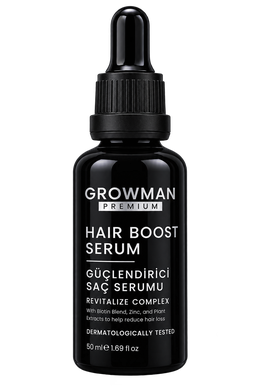
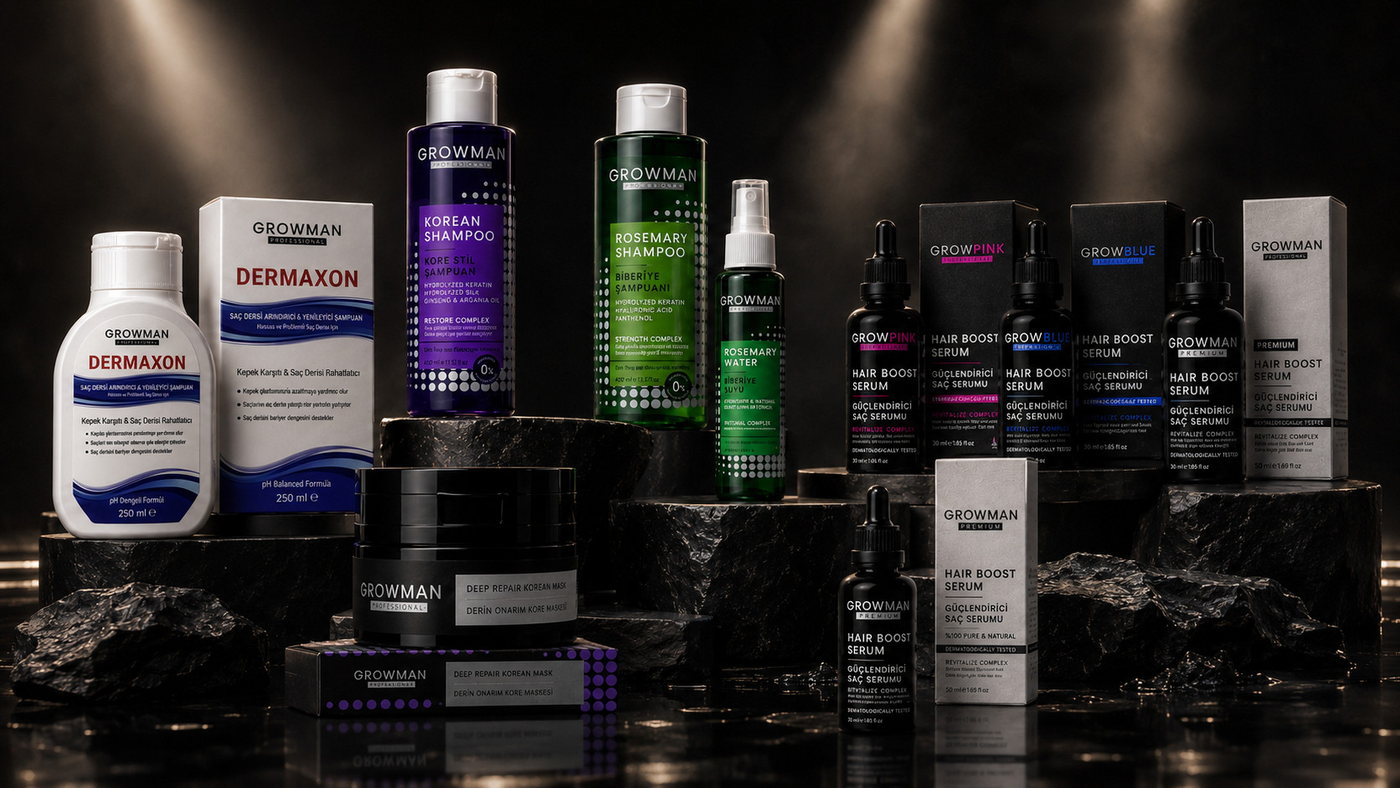
Growman manufactures and exports its own brand from İstanbul: 26 export-ready references across three consumer lines, developed and produced in Türkiye rather than bought in and relabelled. For a first engagement we quote a mixed-SKU structure instead of full pallets, credit the evaluation set against the first wholesale order, and keep one export contact on the file through to reorder. You can see the full commercial framework before you write to us.
Frequently asked questions
Do I register the products myself, or does the manufacturer do it?
In the EU, UK, US, Saudi Arabia and the EAEU, the legal registrant must be established inside that market — normally you, as importer or distributor. The manufacturer supplies the technical file that makes your registration possible, but cannot hold the registration on your behalf.
What is a realistic first order when importing hair care from Türkiye?
No single global minimum exists, because a realistic first order depends on which references you choose and the carton configuration behind them. Most partners start with a mixed-SKU shipment built around a small hero group rather than the full range. Ask for a costed structure rather than a minimum-order figure.
Can I get samples before committing to a shipment?
Yes, and you should insist on it. Ask for evaluation sets containing actual retail product rather than decanted samples, so your team judges texture, scent, packaging and shelf presence honestly. Reputable suppliers credit the sample cost against your first wholesale order.
How long does preparation and shipping take from İstanbul?
Preparation depends on product mix, quantity and stock position, and belongs in writing at quotation stage rather than as a verbal estimate. Transit from İstanbul to the Gulf, the Balkans or Central Europe is short compared with East Asian sourcing, which is one of the stronger commercial arguments for Turkish supply.
Is private label available from Turkish hair care manufacturers?
It varies by producer. Some work primarily as contract manufacturers; others, including Growman, build and export their own brand and review private-label requests case by case against volume, artwork and regulatory requirements. Ask directly before building a plan around it.
Sourcing hair care for your market?
Send us your country, channel and the categories you want to lead with. You get reference numbers, pack sizes, carton configuration and a written commercial framework — usually within two working days.