
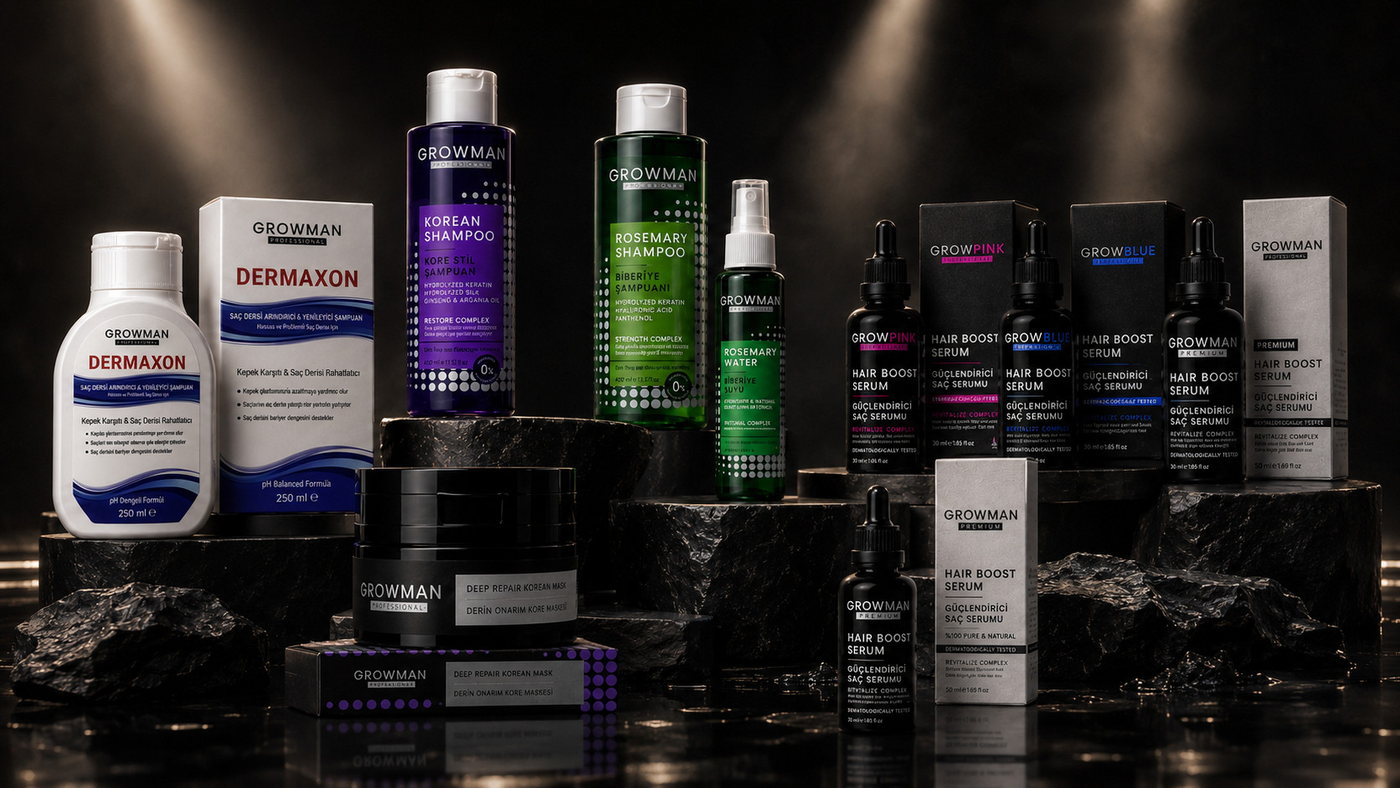
Most hair-care launches that go quiet after the first container did not fail on product quality. They failed on three things decided before anything shipped: the assortment, the pricing ladder and the reorder trigger. This is the sequence we walk through with new distribution partners, mapped onto the first ninety days.
Days 0–15 · Qualify the range against your market, not against your taste
The first mistake is selecting products the way a consumer would. A buyer who picks the references they personally like ends up with a shelf that has no logic — three shampoos that compete with each other and no treatment step to raise the basket.
Before you request a quotation, write down three things about your own market:
- The hair problem that actually sells. In most of the Middle East and North Africa, shedding and scalp condition drive the category. In the Caucasus and Central Asia, repair and smoothness carry more weight. The same 26-reference portfolio produces a very different opening assortment depending on which of those you lead with.
- The channel you can genuinely service. Pharmacy and beauty chains need clean claims and consistent supply. Salon networks need a professional story and a training angle. E-commerce needs images, content and a hero SKU. Pick one to lead with; the other two follow later.
- The registration path and its clock. Cosmetic notification timelines vary from a few weeks to several months. Start this conversation on day one, not after the proforma is signed — it is the single most common reason a launch slips a quarter.
Ask your supplier early: which references have the cleanest ingredient and claim profile for your regulator? It is usually faster to launch with eight straightforward references than to hold the whole range while one difficult formula clears.
Days 15–30 · Build an assortment, not a wishlist
A professional hair-care shelf works on a simple structure: a hero, a routine around the hero, and a small number of specialists that give the shelf credibility without eating your working capital.
The hero
One reference has to carry the story. In our portfolio that is usually the Hair Boost Serum — it has the highest perceived value, the clearest benefit and the best margin per carton. It is what your sales team demonstrates and what your content is built around.
The routine
The hero needs a shampoo and a treatment beside it so the shopper buys two or three units instead of one. This is where a coordinated set matters: a Growpink shampoo, mask and serum sitting together tell one story, whereas three unrelated products tell none. Basket size, not unit price, is what makes a hair-care shelf profitable.
The specialists
Two or three references that solve a narrow problem — anti-dandruff, colour removal, salt-free for keratin-treated hair. They rarely lead in volume, but they make the range look complete and pull in the customer who is searching for exactly that.
For a first order, that structure lands at roughly eight to twelve references, not twenty-six. Ask for mixed-SKU cartons so you can hold that structure without committing full pallets per reference. Testing the market with a broad, shallow assortment beats a narrow, deep one every time.
Days 30–45 · Get the pricing ladder right before you commit
Build the whole ladder on paper before you sign anything. Working from EXW İstanbul, the steps are:
- 01EXW price
Your starting point from the supplier's written quotation.
- 02Landed cost
Freight, insurance, duty, customs clearance, local transport and — critically — the cost of registration and any label localisation, amortised across the first order.
- 03Distributor selling price
Your margin. If you also service retail directly, note that this step and the next collapse into one and your pricing has to reflect it.
- 04Retail or salon price
Where the shopper meets the product. Sense-check it against the two or three brands that already own your shelf.
If the retail price you arrive at sits far above the competing set, the problem is almost never the EXW price — it is usually an assortment with too many low-rotation references carrying registration cost, or a freight plan built for a smaller order than you should be placing. Both are fixable in the quotation stage. Neither is fixable after the goods land.
The one number to protect: the retail price of your hero SKU. Everything else in the ladder can flex. If the hero is mispriced against the shelf it sits on, no amount of promotion recovers it.
Days 45–60 · Documentation, labels and the boring work that decides the date
This is the phase where launches quietly slip. Run these in parallel rather than in sequence:
- Commercial set. Commercial invoice and packing list are coordinated for the confirmed shipment. Confirm in writing which additional documents your customs authority requires, and who issues them.
- Product documentation. Ingredient lists, technical files and any available certificates. Ask for these against specific reference numbers — a generic request produces a generic answer.
- Label localisation. Most markets require local-language elements. Decide early whether these are applied at origin or as a sticker in your own warehouse; the answer changes both the timeline and the cost line in your ladder.
- Trade basis. EXW İstanbul is our standard starting point. If you need an alternative arrangement, agree it in writing before the proforma, not after.
Days 60–75 · Launch mechanics
Goods on a shelf are not a launch. Three things move the first sell-through:
- Sampling into the right hands. Salon owners, pharmacy staff and the people who actually recommend products. A small evaluation set placed with twenty of them outperforms a much larger consumer giveaway.
- One consistent claim. Pick the benefit your hero owns and repeat it everywhere. Claims must stay inside the cosmetic regulations of your market — a range that over-promises creates a compliance problem that is far more expensive than the sales it wins.
- Content built around the routine, not the product. "Shampoo, treat, finish" sells three units. A product photograph sells one.
Days 75–90 · Set the reorder trigger now
The most valuable thing you can do in month three is decide, in advance, what sell-through rate triggers the second order — and place it before you are out of stock rather than after.
Hair care is a repeat-purchase category. A shopper who likes the serum comes back in six to eight weeks. If you are out of stock at that moment, you do not lose one sale; you lose the habit, and you usually lose it to whatever is on the shelf beside you. Build your reorder point from your preparation window plus your freight time plus a buffer, and share your forecast with your supplier so stock can be planned against it.
The short version
| Window | The decision | What kills it |
|---|---|---|
| Days 0–15 | Which problem you lead with | Choosing by personal taste |
| Days 15–30 | Hero + routine + specialists | A wishlist with no structure |
| Days 30–45 | The full pricing ladder | Registration cost discovered late |
| Days 45–90 | Documentation and the reorder point | Reordering only once out of stock |
None of this is unique to Growman — it is how any well-run hair-care launch works. What we can do is make each step faster: give you the reference numbers and claim profiles up front, quote a mixed-SKU structure rather than full pallets, credit the evaluation set against your first order, and keep one export contact on the file from the first enquiry to the third reorder.
Planning a launch for your market?
Tell us your country, channel and the categories you want to lead with. We will come back with a suggested opening assortment, reference numbers and a written commercial framework.